


-6%In stock
NIKON
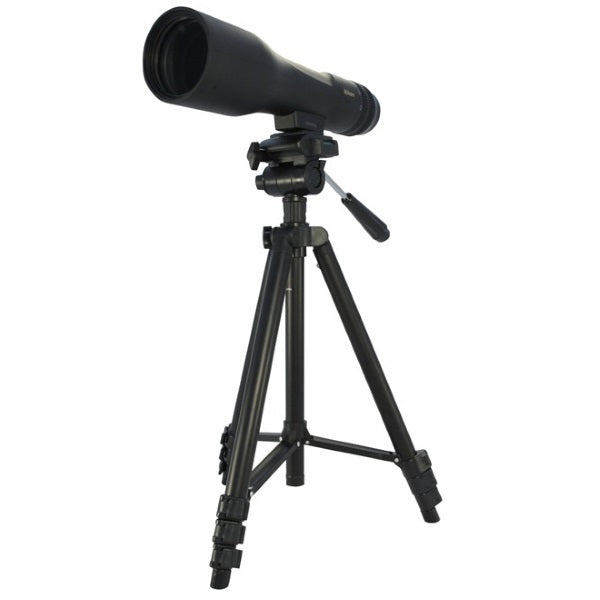
Nikon Prostaff 3 16-48x60 spotting scope - Complete kit with tripod
Official retailer
Nikon
290,83 €
312,50 €
-6%
·
Save 21,67 €
or 3 x 96,94 € interest-free
Magnification
48x60
In stock
·
Order before 2 pm: dispatch the same day. Delivery within 48 hours after dispatch.
Free pickup-point delivery, conditions apply
Magnification
48.0
Objective diameter (mm)
60
Field of view at 1000 m (m)
4à
Close focus distance (m)
10
Waterproofing
Oui
Eyecup type
Réglables
Eye relief (mm)
19 mm à 16x
Exit pupil diameter (mm)
3,8 mm à 16x - 1,25 mm à 48x
The Nikon Prostaff 3 16-48x60 kit brings together everything you need to start observing: a compact 620g spotting scope, a compact tripod and a carrying case. Fully multi-coated optics, integrated 16-48x zoom eyepiece, waterproof construction filled with nitrogen: it is a simple and lightweight solution for discovering ornithology, observing nature, spotting game or following its impacts at the stand from a moderate distance.
A complete introductory telescope, ready to use
The Prostaff 3 is Nikon's entry-level spotting scope, succeeding the Spotter XL II model.Its main advantage is that it is delivered as a kit: no need to look for a compatible tripod or case, everything is provided and stored together.
It must be considered honestly: with a 60 mm objective lens, it has neither the brightness nor the resolving power of an 80 to 85 mm spotting scope, and it does not include ED glass.Its terrain is mobility, simplicity and a contained budget.It is very suitable for beginners, for occasional use or as an easy-to-carry extra spotting scope.

Compact and lightweight: 620 g and 31 cm
Weighing approximately 620 g and 313 mm in length, the Prostaff 3 fits easily into a backpack.This is a real advantage for the observer who walks, hikes or moves from one observation point to another, and who would forgo carrying a heavier telescope.
Understanding 16-48x Zoom: Maximum Magnification Is Not Everything
A spotting scope should not be judged solely on its maximum magnification.The more you magnify, the darker the image, the more the field becomes smaller and the more vibrations and turbulence in the air become visible.On a 60 mm spotting scope, this effect is more marked than on a large diameter model.
The exit pupil, a brightness indicator
The exit pupil is calculated by dividing the objective lens diameter by the magnification.The larger it is, the brighter and more comfortable the image appears.On this 16-48x60 spotting scope, it goes from approximately 3.8 mm at 16x (60 ÷ 16) to 1.25 mm at 48x.
Actual zoom behavior, setting by setting
| Magnification | Main use | Image behavior | Exit pupil |
|---|---|---|---|
| 16x | Spotting, scanning an area, general observation | Brightest image, widest field (approximately 40m to 1000m) | ≈ 3.8mm |
| 24x | Common observation | Good balance between detail, brightness and stability | 2.5mm |
| 32x | Detailed observation | Tripod stability becomes more important | ≈ 1.88mm |
| 40x | Search for fine details | Darker image, more sensitive to vibrations and atmosphere | 1.5mm |
| 48x | Maximum magnification, spot examination | Reserve for good light, a still subject and calm air | 1.25mm |
In practice:
- At 16x, the image is bright and the field wide: this is the setting for finding a bird or scanning a landscape.
- Between 20x and 30x, the Prostaff 3 offers its best compromise between detail, brightness and stability.It is the most useful beach on a daily basis.
- Beyond 35x, the potential detail increases, but the image darkens noticeably with a 60mm lens.On overcast days, at the end of the day or in strong heat, going down to 24x or 30x often gives a more usable image.
A 60mm lens: Mobility first
The diameter of 60 mm explains the compactness and lightness of the Prostaff 3. The counterpart is a more limited collection of light than with an 80 or 85 mm spotting scope:
- In broad daylight, the image is bright throughout the lower and middle part of the zoom;
- When the light fades, at dawn or dusk, it is better to stay on low magnifications, where the exit pupil is largest.
For those who observe mainly at dawn and dusk, or want to regularly use high magnifications, a larger diameter spotting scope will be more suitable, at the cost of a significantly greater weight and budget.
A straight construction
On the Prostaff 3, the eyepiece is in the axis of the body of the spotting scope.This straight construction has several advantages:
- Intuitive aim : we look in the direction of the subject, which helps to find it quickly, especially for a beginner
- Simpler storage in a bag or case.
On the other hand, the tripod must be adjusted higher than with an angled telescope, which makes it a little less stable, and observing upwards (tree tops, cliffs) is less comfortable.Sharing between users of different heights also requires readjusting the height.
The included compact tripod: Practical, with its limitations
The kit includes a compact tripod with adjustable legs, quick-release lever lock and pan head.It allows you to start observing immediately and is easy to transport with the spotting scope.
- At low and medium magnifications, it ensures comfortable and stable observation.
- Around 40x and 48x, a compact and lightweight tripod transmits vibrations and wind more: The image takes longer to stabilize.
For regular use at high magnifications, a stiffer and taller tripod provides a real gain in comfort, for example the Vanguard Vesta 233AP tripod with PH-23 ball head.

Optics: Full multi-layer treatment and ecological glass
Fully multi-coated lenses and prisms
All air-to-glass surfaces of the lenses and prisms receive multiple layers of anti-reflective coating.They limit light loss and parasitic reflections, for a bright, contrasting image with rich colors.
Ecological glass (Eco-Glass)
Lenses and prisms are made without lead or arsenic.
Integrated zoom eyepiece and long eye relief
The 16-48x zoom eyepiece is integrated into the spotting scope: there is no eyepiece to mount or choose.We locate the subject at the lowest magnification, then we zoom in to observe the details.
Eye relief is 19mm at 16x.This generous value allows most eyeglass wearers to see the entire field at minimum magnification.
Waterproof construction for outdoor use
- Nitrogen filling and O-rings : The interior is filled with nitrogen and sealed, which prevents internal fogging during temperature changes.
- Waterproofing : the spotting scope is designed to resist rain and humidity.It is not intended for use underwater.
- Rubberized coating : it ensures a firm and comfortable grip and protects the body against shocks and friction.
Uses of the Nikon Prostaff 3 16-48x60 spotting scope
Getting started in ornithology
Observation of waterbirds on a pond, waders on a mudflat, raptors perched: the kit allows you to get started without having to assemble any equipment.The straight aim makes it easier to find subjects when you're starting out.
Nature observation and hiking
Thanks to its 620 g, the Prostaff 3 is easy to take on walks: chamois or ibexes on a slope, deer on the edge, distant landscapes.
Hunting and scouting
Spotting and observing game remotely from a post, before or during the season.For the detailed assessment of an animal very far away or in dim light, a telescope with a larger diameter will be more comfortable.
Sport shooting at moderate distance
The spotting scope allows impacts to be monitored without moving to the target, when distance, impact size and conditions permit.No precise distance can be guaranteed: visibility of impacts depends on caliber, impact diameter, target contrast, light and atmospheric turbulence.For long-distance shooting, a spotting scope of 80mm or more is more suitable.
Coastal observation and landscapes
Seabirds, boats, viewpoints.At the seaside, waterproof construction is desirable, but heat haze and humid air often limit the benefit of high magnifications.

Prostaff 3 16-48x60 or 80-85 mm spotting scope?
The Nikon Prostaff 3 16-48x60 in kit
- Comes complete with tripod and case;
- Is very light (620 g) and easy to carry;
- Suitable for beginners, for occasional or mobile use;
- Offers more limited brightness and maximum magnification.
An 80-85 mm spotting scope, like the Vortex Diamondback HD 20-60x85 angled
- Collects more light and goes up to 60x
- Is more suitable for long distance and twilight observation
- Weighs almost three times heavier
- Sold without a tripod, which must also be provided.
Technical characteristics
| Brand | Nikon |
| Range | Prostaff 3 |
| Manufacturer reference | BDA202SA |
| Type | Straight zoom land scope, delivered in kit with tripod |
| Magnification | 16x to 48x (integrated zoom eyepiece) |
| Lens Diameter | 60mm |
| Construction | Right |
| Real angular field | 2.3° at 16x |
| Apparent angular field | 35.6° at 16x |
| Field of view | 40m to 1000m at 16x |
| Exit pupil | 3.8mm at 16x;1.25mm at 48x |
| Relative brightness | 14.4 to 16x |
| Eye relief | 19mm to 16x |
| Minimum focusing distance | 10m |
| Lens processing | Full multi-layer |
| Treatment of prisms | Full multi-layer |
| Glass | Eco-Glass ecological glass, lead and arsenic free |
| Waterproof/anti-fog | Yes, nitrogen filling and O-rings |
| Exterior covering | Rubberized coating |
| Length | 313mm |
| Width | 74mm |
| Spotting scope weight | 620g |
Kit contents
- 1 Nikon Prostaff 3 16-48x60 right spotting scope
- 1 compact tripod
- 1 carrying case for spotting scope and tripod
- 1 lens cap
- 1 eyepiece cap
Warranty
The Nikon Prostaff 3 16-48x60 spotting scope benefits from the Nikon guarantee according to the conditions applicable in France.3 years