


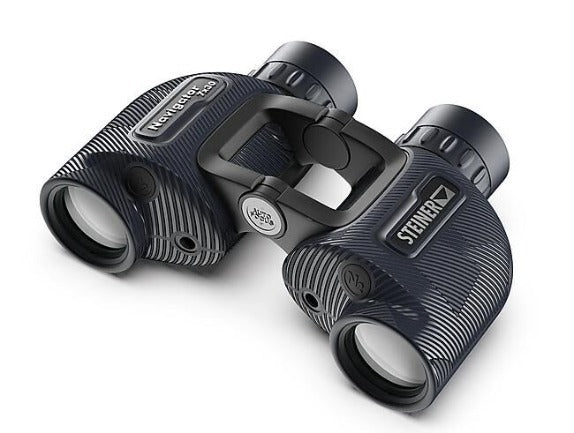


Binoculars can be used for a variety of activities, such as admiring wildlife, spotting birds in the sky or observing marine animals like whales, for example. They can be used day or night, whether for hunting or for stargazing. However you use them, binoculars are an essential accessory for anyone who enjoys outdoor activities, and even more so on a boat. But what should you consider when choosing marine binoculars? And what are the best models for sailing in 2025?
Marine binoculars or ordinary binoculars - what's the difference?
If you're thinking of buying binoculars to take with you on your yacht or boat, you may think that ordinary binoculars will do, and that may be true. But marine binoculars are specially designed for use at sea and, as a result, they come with features of their own that ordinary binoculars don't have.
These features make these binoculars more suitable for navigation and sea use in general.
For example:
- Individual focusing
- Compass
- Rangefinder
- Frame
Individual focusing
With ordinary binoculars you use the central focusing ring to adjust the view for your left eye, then use the diopter on the right eyepiece to make adjustments for your right eye. In contrast, many marine binoculars have individual focusing for each eyepiece.
This can be handy, as you won't need to adjust the focus of the binoculars every time you use them. This can save you a lot of time and trouble if you're using binoculars designed specifically for navigation.
Compass
Many marine binoculars come with a built-in compass to help you find your way at sea. Depending on the binocular, your course can be projected onto the viewfinder or displayed on a digital screen.
Rangefinder
The rangefinder is another useful tool commonly found in marine binoculars. It's often a reticle (grid) that can be used to calculate distances, but some binoculars are equipped with a laser that can calculate distance automatically.
Unfortunately, even if you choose binoculars with a reticle or laser rangefinder, sometimes the result will be inaccurate.
Specifically, with a crosshair rangefinder, you'll need to know the height of your target, then do the necessary calculations to find the distance yourself, which of course can lead to errors.
Laser rangefinders may seem more practical, but they can also be inaccurate on the water. They are also generally more expensive and require batteries.
Frame
While many binoculars, whether ordinary or marine, come with a frame, the latter is particularly important in the case of marine binoculars. After all, you're at sea, and conditions can be rough. The last thing you need is to damage your binoculars by dropping them on deck or banging them against the boat's structure.
That's why many manufacturers produce marine binoculars specially designed to withstand all types of damage, knocks, drops and shocks.
How to choose the best marine binoculars?
When choosing marine binoculars, there are a number of factors to consider :
- Magnification and objective diameter
- Exit pupil
- Environment

Magnification and objective diameter
As most people know, there are always two numbers associated with binoculars. The first indicates the magnification, while the second indicates the objective diameter. Objectives are the large lenses you point at your target, and objective diameter is always measured in millimeters.
For example, 10×50 binoculars have a magnification of 10x and an aperture of 50 mm. The magnification is self-explanatory, as it indicates the size of the object that appears through the binoculars.
While higher magnification may seem like a good idea, don't forget that your binoculars will also amplify the tremors caused, either by your tiring arms or by the boat's movements. The higher the magnification, the greater the shaking.
Also, the larger the objective diameter (also known as the aperture), the more light the binoculars can gather. This parameter is important if you need to use your binoculars at night, at dusk or in low-light conditions, as it will enable you to see more detail. However, there's a downside: the larger the objective diameter, the heavier the binoculars.
With this in mind, 7×50 binoculars can offer a good combination of magnification and aperture. 6x and 8x magnifications are also suitable. A magnification of 10x, on the other hand, could prove problematic, as the movement of the boat would amplify the tremors far too much. A lens diameter of just under 40 mm may still do the trick in low-light conditions. Bear in mind, however, that as soon as the objective diameter exceeds 50 mm, the binoculars become heavy and may quickly tire your arms.
Exit pupil
Perhaps you've never heard this term before. The exit pupil is essentially the diameter of the image formed by the binoculars as it exits the eyepieces and, like the objective diameter, is measured in millimeters. The larger the exit pupil, the brighter and more visible the image. Again, as with lens diameter, this can be important in low-light conditions.
The exit pupil is calculated by dividing the diameter of the binocular objective (again, in millimeters) by the magnification. This is another reason why 7×50 binoculars are a good choice, because as the ratio of magnification to objective lens diameter is large, the exit pupil also offers a wider field of view.
For example:
7×50 binoculars: 50 mm (objective diameter) / 7 (magnification) = 7.1 mm exit pupil
Binoculars 8×42: 42 mm (objective diameter) / 8 (magnification) = exit pupil 5.3 mm
Binoculars 10×50: 50 mm (objective diameter) / 10 (magnification) = exit pupil 5 mm
There are also 6×50 binoculars on the market, which allow you to obtain an exit pupil of 8.3 mm, but they are not very common and therefore not widely available.
The environment
When choosing marine binoculars, it's imperative that they be waterproof and fogproof. You could even say that binoculars without these two features have no place on a boat! Also, choose binoculars with floating collars, as it will be easier to recover your binoculars if they fall into the water.
As mentioned above, don't forget to consider models with a compass and rangefinder, which can make navigation easier, and a shockproof frame to protect your binoculars from possible falls and damage.
Finally, it goes without saying that a boat doesn't offer the greatest stability, which means that what you observe through your binoculars will often look unstable. In this context, therefore, it may be worth considering binoculars with image stabilization. The downside, as you'd expect, is that they cost more, especially if you choose a brand-name model.
Frequently asked questions
What's the difference between marine binoculars and ordinary binoculars?
Ordinary binoculars offer just one function: to magnify your views. However, marine binoculars can be fitted with a built-in rangefinder and compass. You'll also find that they offer individual focusing for each eyepiece, are almost always waterproof and are, in general, more durable than ordinary binoculars. That's why they often cost a little more than other models, and weigh more.
What magnification should I choose for marine binoculars?
As you'll be on the water, it's best to opt for low magnification, to minimize shaking during your observations. The higher the magnification, the greater the movements. It's also advisable to buy binoculars with a larger lens diameter (usually around 50 mm), as these will enable you to observe more in low-light conditions. Binoculars with 6x magnification would be ideal, as they offer low magnification, but as they are harder to find, 7×50 binoculars will also be a very good choice.

What are stabilized binoculars good for?
Whether you're on a boat or on land, the normal (and minor) tremor of your arm will be amplified by your binoculars, causing the view to shake. It's obviously much worse on a boat, because of the movement of the waves. Binoculars with image stabilization try to compensate for this phenomenon and offer a more stable image. As these binoculars use an internal electronic system to stabilize the image, they can be more expensive than ordinary binoculars.

Stabilized Kite Optics



